


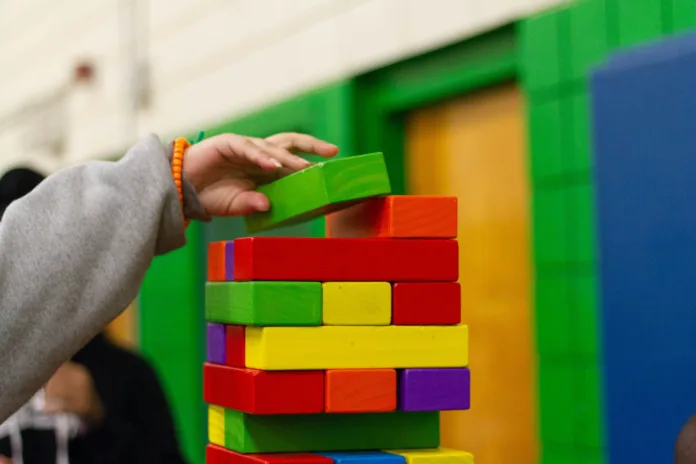
“Play is often talked about as if it were a relief from serious learning. But for children, play is serious learning.”
– Fred Rogers
I banned my IFC from using artificial intelligence (AI) to do their work for them.
Really, I have set an expectation that they are sitting in the work, thinking about issues, and trying their best to solve them. No task is allowed to be done with AI – even the ones that seem the most tedious and mundane, like taking minutes at president council meetings, or those that seem daunting, like creating a social media plan. Are they still using AI when I am not around? Probably. But I do know that they are trying to think about what is happening and what to do next, and I can tell by the quality of their work and the questions they ask. This is an expectation that I set at the beginning of their term and reinforce throughout the year. It is not one that comes without complaint (or even begging from a student or two), but I’m resolute in this stance, as I believe this is important in today’s world.
My motivation for not allowing AI use in the council room is not political, motivated by environmental concerns, or fueled by fear of technology (though let me be clear that there are plenty of political, environmental, and social concerns that I hold). Rather, I made this choice because I want my leaders to play and get dirty while discovering new ways of thinking, moving, and doing.
An analogy that I have always heard, and now use to explain my rationale, is that organization membership and leadership during college are meant to be a sandbox where students can try new things, have new experiences and feel safe to fail. I love this imagery because it helps us imagine something that might be scary and daunting and makes it feel more manageable.
Think back to when you were a kid, or observe how kids in your life engage with each other. Play is the most serious thing that they can do. Their play is full of imagination, taking them to other worlds and on adventures. It’s the same thing for our college students; now they have moved from the playground to our student unions and fraternity houses. If they use AI, they’re taking themselves out of the sandbox and are effectively bystanders in their own leadership roles, as ChatGPT and Claude do all the thinking for them.
An argument for the use of AI that I often hear is that it will make tasks easier and get done faster, or that it helps with idea generation. I will not deny that those can be true, but at what cost? Programs look the same from student to student and organization to organization because the same software creates them. Students do not know how to implement the event because they did not have the vision or idea to make the plan and are just reading the outline of a program like instructions from a LEGO set. If they are not sitting with the problem they want to solve or thinking about the event they want to hold, they are not getting the skills they need and developing into thinking, feeling, and executing leaders and people.
Student development theories support this, too. Chickering, Kohlberg, Perry, Astin, and others talk about the process of development through a student’s time in college, and each talk about important moments that students must experience in order to move on to the next stage of their development (Long, 2012). Astin recognized the importance of students’ involvement outside of the classroom through extracurriculars and student organizations, engaging with faculty, and spending a considerable amount of time on campus. Astin believed that there are quantitative (time invested by students) and qualitative (seriousness with which students approach their work) features of involvement. In other words, if students are invested physically and emotionally, their overall learning will increase because they themselves are invested in the outcomes.
AI does not fit into that equation at all! In fact, AI would detract from both the emotional and physical investment because it is being used to save time or to do the hard brainstorming sessions that students (and staff) are trying to bypass. Not only will using AI create monotonous programming, but it will hinder our students’ ability to learn and develop as involved citizens on our campuses.
How do we continue to create a space for students to learn and develop skills? Let’s go back to our sandbox. Every sandbox has walls and a floor. Create the boundaries and allow your students to explore and play within them.
Mike Schur, the creator of classic sitcoms such as the American version of The Office, Parks & Recreation, and most recently Hacks, was on the May 20, 2025, episode of “Good Hang with Amy Poehler,” where the two reconnected and talked about working together and with other funny and creative people. In the episode, Schur talks about how he loves systems and how he creates them to allow for freedom to do their best work. He says,
“All you have to do is, like, set up the boundaries. You put out the gate and you…lay out the fence, and you’re like ‘anywhere in here is fine’… Once you’ve, I believe, set up a sort of like boundary and like a mechanism and, like, ‘you’re going to be in the yard from 2:00 to 4:00. Here are your toys. You can do anything you want from 2:00 to 4:00, and then you’re back inside.’ And then you get the funniest people you can, who are the most comfortable and happy. And you say, like, ‘Don’t worry, everything’s taken care of. Rules are in place, fences in place. Go crazy.’ And you let, like, people do their best, most fun, most joyous work. I really believe, and this isn’t revelatory, but I really believe that is the best way to work creatively within a group” (Poehler, 2025).
Schur, a leader of creatives and a creative in his own right, lays out plainly and simply all that it takes to be creative, make good products, and have fun while doing so! Let’s take a page out of his book and create our boundaries, our fences, our sandbox walls, and let our students play! And set the expectation that their play is genuine, authentic, and their own.
References
Long, D. (2012). Theories and models of student development. In L. J. Hinchliffe & M. A. Wong (Eds.), Environments for student growth and development: Librarians and student affairs in collaboration (pp. 41–55). Chicago: Association of College & Research Libraries.
Poehler, A. (Host). Schur, M. (Guest). (2025, May 20). “Philly Justice” [Podcast episode] in Good Hang with Amy Poehler. The Ringer and Paper Kite Productions.
About the Author

Charlie Presar currently serves as the assistant director of fraternity & sorority life for student leadership development at William & Mary. In this role, he is the primary advisor of the Interfraternity Council, Multi-Cultural Council, all chapters therein, and supports the Panhellenic Council and National Pan-Hellenic Council. He also serves as the co-chair of W&M’s Hazing Prevention Coalition. He earned his bachelor’s degree in history from Valparaiso University, a master’s degree in higher education from Elon University, and is a member of Sigma Phi Epsilon Fraternity. Outside of his professional role, he volunteers as the Balanced Man Steward for two SigEp chapters, advising and supporting each chapter’s member development programs. Charlie also facilitates educational programs for Sigma Phi Epsilon and Phi Gamma Delta fraternities.