
Before AFA was Established
The idea of AFA did not begin in Williamsburg. It began with a newsletter. In September 1973, following that summer’s Interfraternity Institute (a program designed to build connection and community between campus-based fraternity/sorority professionals and headquarters-basedfraternity/sorority professionals), a group of campus advisors launched the Fraternity Advisors’ Newsletter: eight issues for a $10 subscription, edited by Jerry Lilly of Kansas State University, with an editorial board that answered subscribers’ questions in print. Alongside it ran an even looser body: a Fraternity Deans Association coordinated since roughly 1970 by Jim Brooks at the University of Kansas, whose principal function was circulating materials produced on member campuses. In July 1974 the two merged into the Fraternity Advisors Association (FAA) and the Fraternity Newsletter, available together for $12 a year (History of AFA, archival notes, 1973–1978).
The FAA was an association in name only. It met infrequently and deliberately imposed no structure on itself until members proposed clearer purposes. But Lilly had already named the need in print. In September 1974 he argued that there ought to be an association of fraternity professionals devoted first to continuing education, one that could give the men and women serving as fraternity advisors and deans a recognizable identity within the student personnel field. Three months later he asked the question that would become AFA’s founding logic. There was no reason, Lilly wrote, for the NIC, FEA, and FAA to keep meeting at separate times in separate places (Lilly, 1974).
Setting the Stage for the Need for AFA
The urgency behind Lilly’s question came from a structural change on campuses. Through the early 1970s, as fraternities and sororities emerged from the unrest of the Vietnam era, colleges quietly reassigned responsibility for them. The deans of men/women and the dean of students gave way to a new position: often younger and junior, shifting towards early-career student personnel professionals. Those professionals had less standing than their dean predecessors and no professional community.
Bill Jenkins, then executive director of Phi Kappa Tau, described their place in the campus hierarchy with unusual bluntness:
“The student personnel person, man or woman, was pretty far down the [List]… the person in a closet next to the men’s room someplace down the hall — that was their office.”
Bill Jenkins, AFA Treasurer, 1977
John Mohr, who would become AFA’s first president, felt the same isolation from inside the academy…The sense that working with fraternities marked you as something less than a full colleague.
““College staff people felt a little bit like… outcast, because you could be typecast as a role of a fraternity person or a sorority person, but didn’t necessarily bring a great deal of respect from your colleagues.”
John Mohr, AFA President, 1977
The ‘Idea’ in Williamsburg, VA
The catalyst for AFA’s founding was the National Interfraternity Conference’s bicentennial gathering at the Williamsburg Inn, marking 200 years since the founding of Phi Beta Kappa, the blueprint for the modern college fraternity. Its theme was “A Look to Our Past.” The NIC had worked to draw campus advisors in large numbers. Providing for them the opportunity to explore this new community.
Barbie Tootle, then one of very few women in the field and the first woman to hold her role at The Ohio State University, remembered the conversation taking shape informally, in a hotel bar:
“The more people talked, the more it started to become a little more concrete about — maybe we really should do this. Maybe we should form an organization, a professional organization.”
Barbie Tootle, AFA President, 1978
Two fraternity executives, Bill Jenkins of Phi Kappa Tau and Bill Schwartz of Sigma Alpha Mu, helped to engineer the opportunity and then stepped back, giving the campus professionals room to build something of their own. Sid Dunn, who later wrote the Fraternity Executives Association’s history, was clear about whose association it was meant to be:
“The key was to provide mutual support for Greek advisors… it was for the Greek advisors who had relatively low status in the overall university hierarchy and who probably needed support.”
Sid Dunn, Early AFA Founder
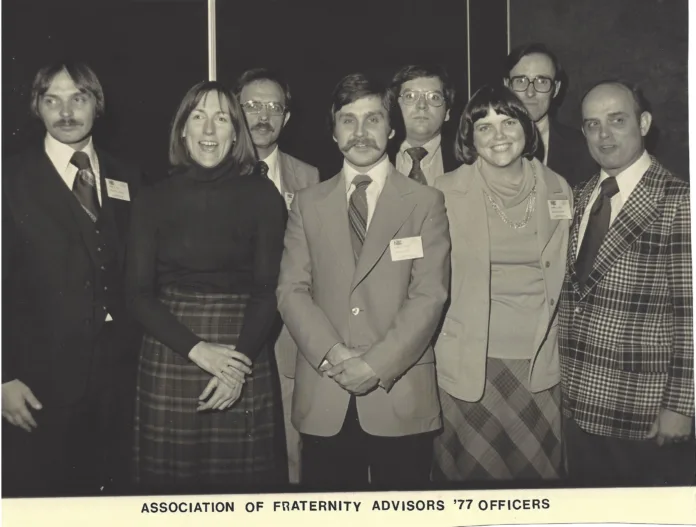
NIC Annual Meeting on December 1, 1976, chaired by AFA’s First President John Mohr and including Jenkins, Schwartz, Tootle, Lilly, Jerry Gallups of Georgia Tech, Tom Fiutak of Cornell, Michael Palm of Kentucky, and Darrel Troxel of Pan American University (developed into University of Texas – Pan American, now known as University of Texas – Rio Grande Valley). On January 20, 1977, Mohr, Jenkins, and Tootle met at Phi Kappa Tau headquarters in Oxford, Ohio and produced a draft prospectus, circulated to the field with a handwritten request for reactions by February 15. Its prologue is the earliest written statement of AFA’s reason for being:
“During discussions at the Bicentennial NIC Conference in Williamsburg, several fraternity deans and executives brought up the need for having an ongoing professional organization composed of college and university staff members with job responsibilities related to the advising of fraternities and interfraternity councils.”
AFA draft prospectus, January 1977
AFA’s First Meeting(s)
The formal organizational meeting convened in Indianapolis on June 11–12, 1977.
Attendees elected Mohr as president through December, set a dues structure, agreed on a working organizational document, and voted to abolish the FAA. Tootle and Mohr drafted the constitution between them across a year of meetings in Oxford, Columbus, and a Holiday Inn in Richmond, Indiana, chosen because it sat halfway between their campuses — typed, mailed, and revised without staff support of any kind.
Two provisions of the adopted constitution deserve attention, because both are arguments about legitimacy. The first is a purpose absent from the January draft: to formulate and maintain high professional standards in the advisement to fraternities. The second is structural. Regular membership, with the vote and eligibility for office, was reserved for campus-based staff; fraternity executives and volunteers were welcomed as associate members who paid dues and received benefits but could neither vote nor hold office. The founders accepted the interfraternal world’s help while writing its authority out of the governing document.
AFA’s first Annual Meeting was held December 1–3, 1977, at the Hyatt Regency in Indianapolis, in conjunction with the North American Interfraternity Council (NIC). Eight educational sessions drew roughly 70 participants. That December, AFA also assumed responsibility for editing and distributing the Fraternity Newsletter, the publication that had called it into existence. The December 1977 issue printed the attendance list with a note that it would make a good historical record. Shelly Sutherland, later the 1983 president, remembered the era’s convening power as its real innovation:
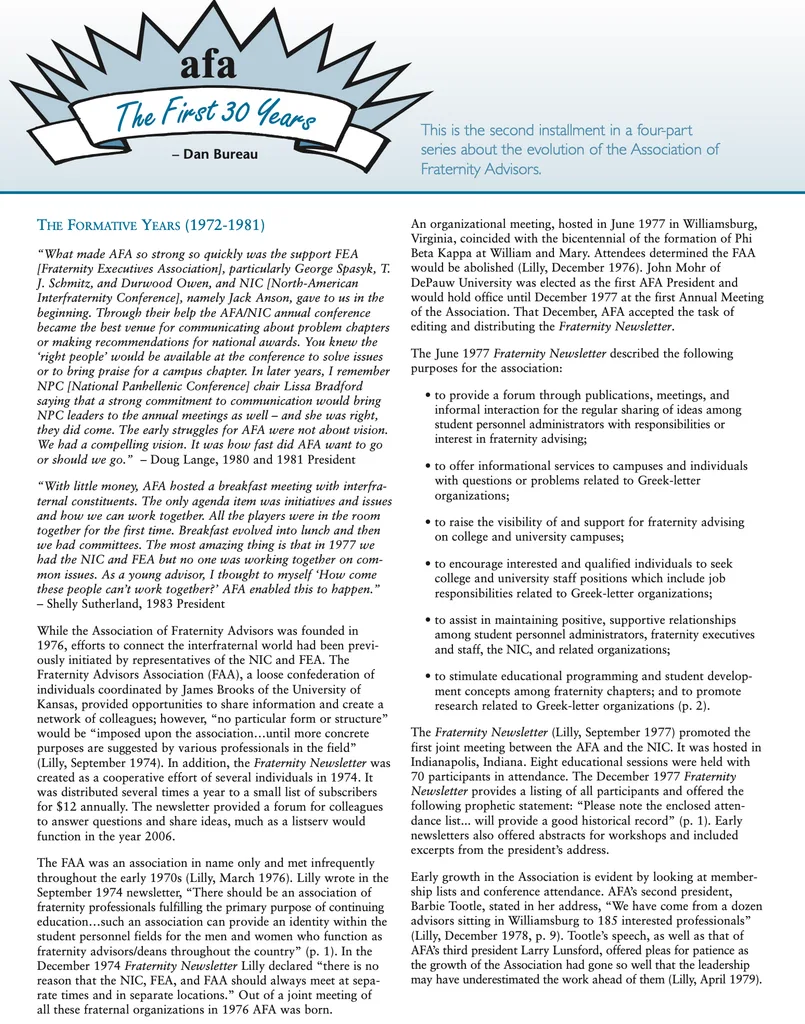
“With little money, AFA hosted a breakfast meeting with interfraternal constituents… All the players were in the room together for the first time… In 1977 we had the NIC and FEA but no one was working together on common issues. As a young advisor, I thought to myself, ‘How come these people can’t work together?’ AFA enabled this to happen.“
Shelly Sutherland, AFA President, 1983
As reported by Dan Bureau in Perspectives Spring 2006 issue
AFA’s Growing Pains
Growth was immediate and nearly overwhelming. In her 1978 address Tootle reported that AFA had gone from a dozen advisors sitting in Williamsburg to 185 interested professionals (Lilly, December 1978, p. 9). Both Tootle’s and Lunsford’s presidential addresses included open pleas for patience; the growth had gone so well that leadership had underestimated the work it created (Lilly, April 1979).
Institutional fragility arrived just as fast, and the constitution’s vacancy clause got more use in five years than anyone anticipated. Some of AFA’s early presidents had to either resign their posts entirely mid-term, or prior to them taking office, forcing those in waiting to take those positions earlier than expected (Beyers, April 1979; Beyers, January 1982). There was no staff and no budget to absorb any of it. AFA held its 1978 meeting only because Jenkins and Schwartz secured breakout rooms on its behalf; Tootle recalled plainly that there would have been no meeting otherwise, because AFA had no money, and that the two executives coached the young board on how to navigate these complicated waters.
Establishing AFA as a Leader in the Interfraternal Space
The deeper struggle was for respect and for the opportunity to make a difference. AFA’s members were young and their tenures short, while the executives within our interfraternal community had often held their posts for two and three decades. AFA answered by insisting on a wider table. One of the era’s defining acts was the decision to invite the National Panhellenic Conference to AFA’s annual meeting, a move that was controversial at the time.
When Barbie Tootle became the first woman seated at the head table of an NIC banquet, she deliberately wore a tuxedo-style jacket rather than a formal gown, and endured a seatmate who lit a cigar over dessert, a gesture she read as a message about whose club she had entered. She kept the seat.
“He’d been a pleasant enough dinner companion, but he was clearly not happy that I was there. And that was confirmed when he lit up a big cigar.”
Barbie Tootle, AFA President, 1978
Between 1979 and 1981, presence became substance at a remarkable pace. AFA conducted its first membership assessment in 1979, gathering demographic and position data on the field it represented. It adopted its first position statements on hazing and on alcohol misuse, passed a resolution urging colleges and universities to employ a professional staff member whose time in fraternal affairs was commensurate with campus need, and established the Robert H. Shaffer Award. A Code of Ethics and a manual for professionals followed. In 1981 AFA joined the Council for the Advancement of Standards, placing itself alongside the recognized bodies of higher education, and NPC chair Mary Barbee delivered a resolution formally deepening NPC’s involvement with the Association (Beyers, February 1981; Beyers, May 1981; Beyers, September 1981; Beyers, January 1982).
AFA Steps into its Own
This era closed with an act of separation that functioned as a certificate of maturity. In the summer of 1981 the FEA Advisory Committee, the body that had guided AFA from its first days, was dissolved by mutual agreement. Doug Lange reported it in his December 1981 State of the Association address:
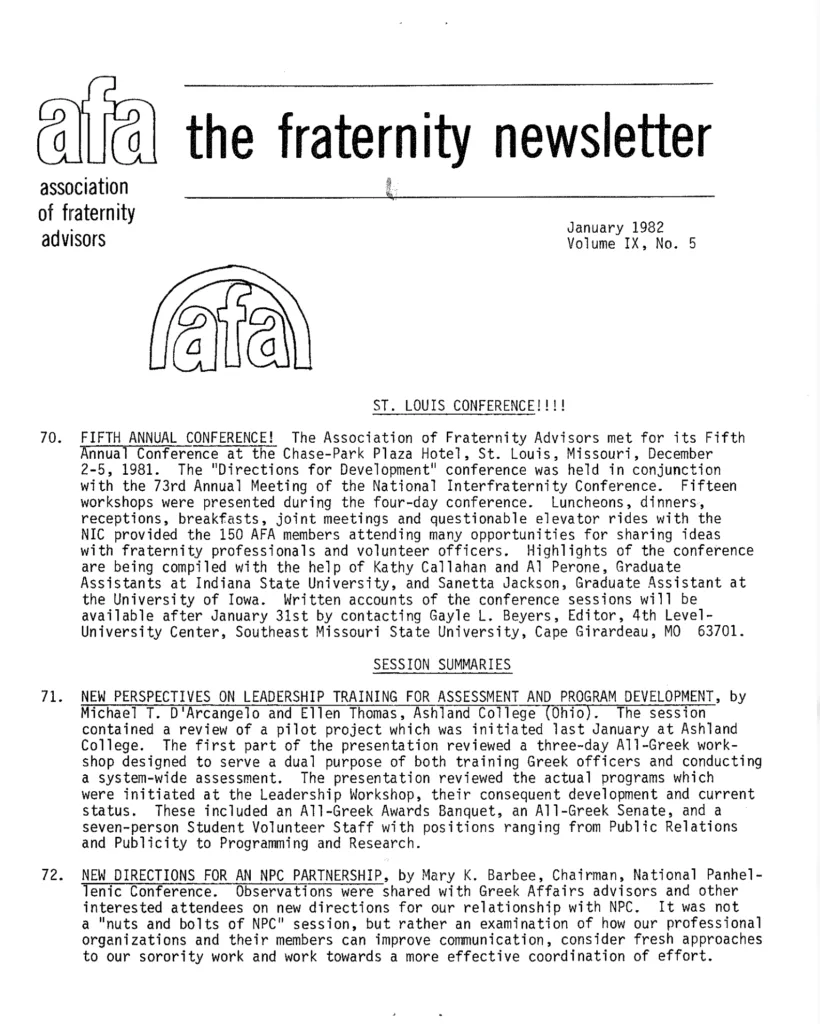
“Both groups were mutually agreeable with the fact that AFA was a group ‘unto its own’, stable in leadership, stable in membership with a solid financial status.“
Doug Lange, AFA President, 1981 & 1982
January 1982 The Fraternity Newsletter
Membership stood at 499. Lange later reflected that AFA’s early struggles were never about vision — the vision was compelling and shared; the argument was over how fast the Association should move (Bureau, Spring 2006, p. 10). Lunsford framed the era’s central lesson in a line he borrowed from Alpha Phi’s Betty Mullins Jones and used for decades afterward:
“We’ve not always been good to each other, but we’ve been good for each other.”
Larry Lunsford, AFA President, 1979 & 1980