
After “Unto Its Own”
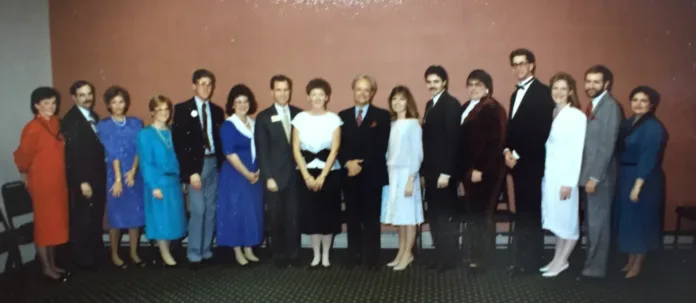
AFA entered the 1980s with a constitution, a newsletter, and a seat at the Council for the Advancement of Standards in Higher Education (CAS). The FEA Advisory Committee had dissolved in the summer of 1981, and the Association was, in Doug Lange’s phrase, a group unto its own. What it did not yet have was a settled idea of what it would become. Dan Bureau later called these the Years of Progress; Gary Bonas, looking back from 2006, compared the Association to an adolescent seeking “a sense of identity” and struggling with “independence (or interdependence)” from the organizations that had raised it (Bureau, Summer 2006, p. 8).
Lange, who had been catapulted into the presidency when Bill Brennan stepped away in 1981, described the period that followed less as a series of decisions than as a series of discoveries:
“There weren’t so many decisions made as there were discussion items discovered… You have to remember when I was president, we were only four and five years old. It was a discovery time.”
Doug Lange, 1981 & 1982 President
The work of the era was concrete all the same. Presidents and board members spent hours with “sheets and sheets of paper trying to determine who’s a member, who’s not a member, who’s paid dues” (Lange, 40th Anniversary Oral History Project), because membership was the Association’s only reliable revenue and its only proof of relevance.
Joining the Profession
The era’s leaders pursued standing in higher education as deliberately as the founders had pursued a separate identity. AFA had joined the Council for the Advancement of Standards in 1981, and Lange served as its CAS delegate from that year for more than three decades. Under Lange’s leadership, AFA also secured an agreement that NASPA and ACPA would include at least one fraternity/sorority program at every national conference, years before either body had a formal commission or knowledge community for the field (Lange, 40th Anniversary Oral History Project).
“We really wanted to be professionals in every step of the way… There was no other group on the planet that worked toward professionalizing and detailing the work of a fraternity and sorority advisor.”
Doug Lange, 1981 & 1982 President
Legitimacy was harder to win on campus. In his 1985 report, Victor Boschini told members plainly that fraternity/sorority advising “is not now, and will probably never be, a top priority with too many university/college presidents… We need to admit that we augment a good education; we do not initiate it” (Boschini, February 1985, cited in Bureau, Summer 2006). He later expounded on this as the central issue of his term, especially compared to the North American Interfraternity Conference (NIC), National Pan-Hellenic Council (NPHC), and National Panhellenic Conference (NPC):
“I think the number one was gaining legitimacy as an organization. You know, there was the NIC and the NPHC and the National Panhellenic [Conference]… They were all there a lot longer than AFA was.”
Victor Boschini, 1984 President
The Bridge Builders
If the era had a governing method, it was convening. Shelley Sutherland, AFA’s first member and its 1983 president, arrived with a single goal: to stop the interfraternal world from duplicating its own work. National organizations were each spending heavily on the same hazing prevention and education programs, and none knew what the others were doing.
“Each of the five of them do an awesome job, but in reality, each of them are doing the same job. They’re inventing wheels. So my goal was to try to get everybody to talk to everybody else about what they were doing and what their priorities were.”
Shelley Sutherland, 1983 President
AFA found the money to host an early breakfast for executive directors, magazine editors, and NPC delegates, asked each to name their organization’s priorities, and paired those working on the same issues. It ran for five or six years; once the groups were working together on their own, AFA stopped paying for it (Sutherland, 40th Anniversary Oral History Project). The same instinct produced the fireside chats, created to replace hallway confrontations in which campus advisors cornered a national president over a chapter problem, with Richard Walker as their first coordinator (Sutherland, 40th Anniversary Oral History Project). The Buddy System and Host/Colleague programs, founded in 1982, paired first-time attendees with experienced advisors who knew which campuses and organizations to learn from (Sutherland, Sutherland, 40th Anniversary Oral History Project).
Sutherland counted the bridges themselves as the achievement of her term:
“I would be pleased if the only thing I did was enable people to figure out who to talk to and how to understand the problem from both sides.”
Shelley Sutherland, 1983 President
Structure for a Growing Association, 1984–1986
Growth forced structure. As program chair for the 1983 meeting, Boschini watched business meetings stretch on as the Association neared, by his recollection, about 300 members. As president in 1984 he introduced regional distinctions and regional meetings at the conference, which later grew into elected regional vice presidents on the Executive Board (Bureau, Summer 2006).
“Let’s have regions that could do a lot of the work in the region and then just report out at the big meeting… It was a hit the moment we started it.”
Victor Boschini, 1984 President
Recognition followed. In 1985, under Barb Robel’s leadership, the executive board began holding mid-year meetings at the conference site and created the Distinguished Service Award. In 1986, under Gayle Webb, who had edited the Fraternity Newsletter since her undergraduate years as Sutherland’s student at Indiana State University, the Association distributed its Greek Advisor’s Manual after three years of development, and returned to St. Louis for its tenth anniversary.
Running on Volunteers
All of the work of AFA was accomplished without staff, an office, or computers. Officers did AFA’s work from their campus desks, assuming their supervisors permitted it. Board meetings were piggybacked onto the Interfraternity Institute in Bloomington, with members sharing cheap hotel rooms and driving in when they could (Webb, 40th Anniversary Oral History Project). Secretary Sonia ImMasche of Colorado State University carried the Association’s institutional memory in a trunk she brought on the airplane to every meeting, holding every set of minutes in case a past resolution was needed (Webb, 40th Anniversary Oral History Project).
“We had no money, so we had to beg… and borrow for everything. We were at the mercy of our schools a lot of times. And so if you took a new job and your new supervisor wasn’t as sympathetic towards the cause… you weren’t going to be spending much time with it.”
Victor Boschini, 1984 President
Turnover made the strain worse. With advisors averaging two to three years in the role, Boschini recalled that early awards were almost passed around, because anyone with three years in the field “sometimes… [had been] there longer than anybody else in the room” (Boschini, 40th Anniversary Oral History Project). Lange and his peers worried openly about who would lead once the first eight or nine presidents had served:
“We were nowhere near prepared to hire anybody like today… So we were all on the backs of volunteers. And how do we survive with this volunteer effort?”
Doug Lange, 1981 & 1982 President
A Wider Table
The era also widened the definition of who belonged. Sutherland remembered that in the early 1980s “there were lots of men who didn’t like the women,” and that as one of the first women advising fraternities she “just had to build a lot of bridges and teach a lot of people” (Sutherland, 40th Anniversary Oral History Project). AFA invited Eileen Stevens, whose son had died in a hazing incident, to address a meeting held jointly with the NIC. Webb recalled that “everybody was a little nervous” about how the NIC would react, and that it embraced her. Stevens received the Anson Award in 1984 (Webb, 40th Anniversary Oral History Project).
Relationships with the historically Black fraternities and sororities began more warily. Lange recalled attending an NPHC meeting in Atlanta where leaders were skeptical of AFA’s motives and willing to communicate but not yet to become involved (Lange, 40th Anniversary Oral History Project). By 1990 Paul DeWine had made NPHC a presidential priority, building a working friendship with its president, Daisy Wood, and inviting her to speak on his campus:
“I actually attended [THE NPHC] national conference on behalf of AFA, and I think I may have been the first AFA president to ever attend their conference.”
Paul DeWine, 1990 President
The conference itself changed, too. Gary Bonas arrived at his first AFA meeting in St. Louis in 1981 convinced he could not be his authentic self among the fraternity and sorority crowd. Over the decade, he found others who shared his need for community and authenticity, and by the time AFA held its meeting in San Francisco, they founded Chi Epsilon, which he noted has since grown far beyond that first group.
“The other thing that has clearly changed, and it was fun to be part of that change, was the group’s development of a very inclusive attitude… I went to that first conference in St. Louis thinking, I’ve got to act very straight.”
Gary Bonas, 1987 President
Bonas also recalled a dearth of people of color at that first meeting; one of the professionals of color in attendance was the mentor with which he was paired (Bonas, 40th Anniversary Oral History Project). However, the Association’s commitment to inclusion was growing. In 1988, the board voted unanimously to move the Annual Meeting from Phoenix to San Francisco in protest of Arizona’s refusal to recognize the Martin Luther King Jr. holiday, and in 1990 members passed a resolution on heterosexism within the fraternity/sorority community.
Pressure from Outside
The decade closed with the fraternal system under scrutiny. Amherst and Colby abolished fraternities in 1987; Bowdoin, Gettysburg, and others debated similar moves. Bridget Guernsey Riordan, president in 1989, recalled AFA writing to boards of trustees and joining with interfraternal partners to point out the alumni support available to campuses (Guernsey Riordan, 40th Anniversary Oral History Project). A white paper from the American Council on Education drew particular concern:
“There was a lot of concern that it was being written by folks who weren’t actually in the trenches… how you know exactly what’s going on with our undergraduate students from a 10,000 foot view.”
Bridget Guernsey Riordan, 1989 President
When the paper was released in 1990, Paul DeWine found it “very challenging to develop a consensus among the membership and the leadership of the membership on how to respond” (DeWine, 40th Anniversary Oral History Project). Risk management emerged as the next defining issue; in her 1989 State of the Association, Guernsey noted that members welcomed new fraternity risk management standards but were “concerned about the enforcement of these policies” (Guernsey, 1989, cited in Bureau, Summer 2006). AFA answered by planning: a strategic planning process began in 1989, and a comprehensive marketing plan followed in 1990.
AFA’s second era turned an independent association into a professional home. It established three patterns that still define the Association: that AFA’s influence would come from convening rather than authority, bringing campuses, national organizations, and umbrella groups into the same room until they could work together without it; that independence from its founding partners would be negotiated rather than declared, through equal footing, compromise, and the patience to remain at the table; and that the Association would widen its own definition of belonging, to women advising men’s groups, to NPHC, and to members who had not seen themselves at the conference. By 1990 AFA had regional structure, a manual, recognition programs, a presence at NASPA, ACPA, and CAS, and a strategic plan. It still had no staff. Paul DeWine remembered “the day way back when we just first started talking about the possibility of an executive director” (DeWine, 40th Anniversary Oral History Project). That conversation, and the central office that followed in 1993, would define the next era.